The silent suffering within good shepherd convent
From morning to night, we were controlled, disciplined, and stripped of our individuality. Our days were filled with endless, unpaid work in the laundry, our youth vanishing amidst the steam and scrubbing. This was not a place of rehabilitation, but one of exploitation, where young girls were dehumanised and their spirits crushed, all while generating revenue for institutions that claimed to offer care.
Echoes of the past, voices of strength
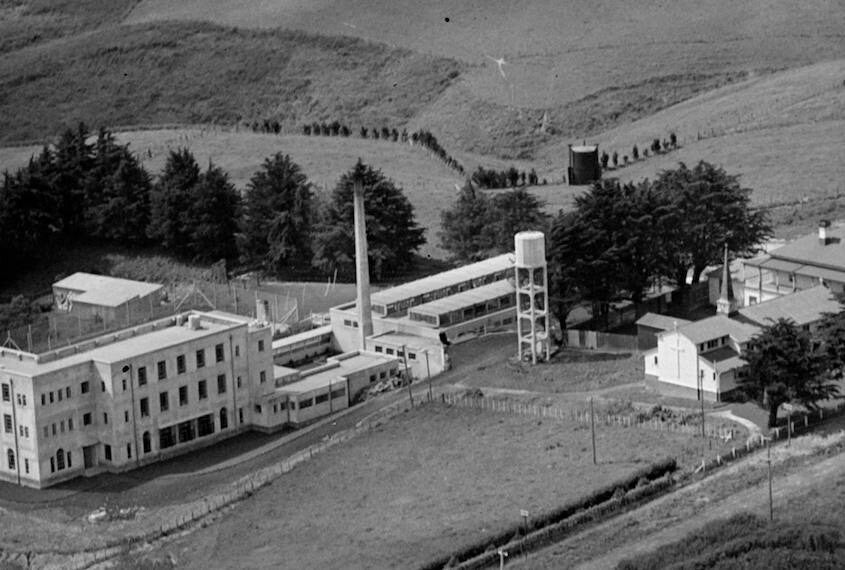
I am a survivor of the Good Shepherd convent, known as 'The Magdalene Laundry,' in Auckland. My teenage years, and those of many others, were stolen by a system of forced, unpaid labour, under the guise of retraining. This page shares my journey through dehumanisation and institutionalisation, revealing how the Catholic Church and State collaborated to profit from our stolen youth. This is my story, a testament to resilience and the path to reclaiming our lives.
A collaboration of controls
The alliance between the Catholic Church and the State created an inescapable system. Our rights were ignored, our families often unaware or powerless, and our voices silenced. This collaboration produced revenue, but at the devastating cost of countless teenage girls' lives, their potential stifled, their futures irrevocably altered. This page is for those who endured similar injustices, and for their families.
Reclaiming our narrative, embracing freedom
For survivors and their families, understanding what happened is the first step towards healing. This page aims to be a beacon of information and empowerment, helping you to shed the shame and reclaim the narrative of your life. BreakthroughOptions is dedicated to supporting survivors of abuse, providing tools to build awareness and move forward with strength.
I tell the story of my time in the Magdalene Laundry with my own art and memory, as it unfolded. For those who lived through it, may you find healing. For those who didn’t but knew someone who did, may you find understanding of a terrible time in our history.

In 1964, I was fourteen years old when I ran away from home because a close family member raped me. I was rebellious, defiant and angry and I couldn’t tell anyone that I was hurt, confused and saturated in shame.
Three days later I was picked up by the police and went to court, where they legally declared I was, “not under proper supervision.’’ I was made a State Ward and put into a girl’s home, where they put me into a cell, underneath the house for weeks, until I went before the judge in the Children’s Court. My life was not my own from that moment on, as others determined my future. I was sentenced as a runaway and transported from the courthouse to The Good Shepherd Girls Home for ‘retraining.’


As I stepped through the doors of The Good Shepherd Convent, the process of dehumanisation began almost immediately. I was handed a uniform, shoes, socks and underwear and then led to the ablution block, where I was forced to remove all my clothing and hand them over, removing any trace of my personal identity.
They read the rules to me as they cut my hair crudely, robbing me of my dignity and individuality.
I was marched into another cubicle, where a bath had already been prepared and told to put my ‘new’ clothes on the side table. I felt shame as I stepped into the bath, whilst being watched by the nuns. There was no soap available; however, a nun arrived carrying a tin of DDT disinfectant and poured it into the bath, as she berated me for my shameful, rebellious behaviour. She said I was there because of the shame I brought to my mother; and likewise, to the Catholic Church and I should consider myself privileged to be given the opportunity to do penance and be redeemed.



Next, I was taken to the dormitory and told it was forbidden to talk to the other girls and I was warned not to address them for any reason or there would be consequences. I was too scared to talk anyway as my world was shaken and whirling around me as I was thrust into a restrictive, sterile environment.
I was awakened (at dawn) by a nun walking through, ringing a bell, and immediately sent to the showers and dressed in my new, disgusting, uniform. Not being able to speak, I just followed what the other girls did.
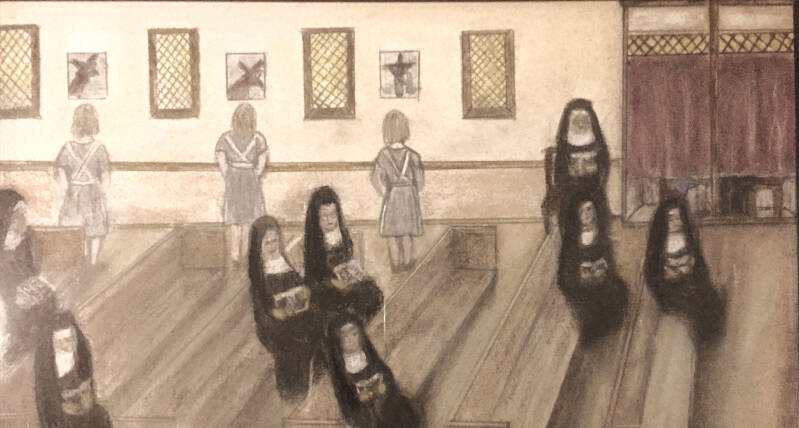
I followed the other girls to the chapel, where we faked contrition, as we stood in front of the ‘Stations of the Cross.’ This was to show us that our sufferings were nothing compared to the suffering of Christ.
After chapel, we were herded into the dining room and lined up to the servers and received our breakfast, more prayers were said before we were permitted to eat. All this was done in unbearable silence. Hard to do when you are an extrovert.
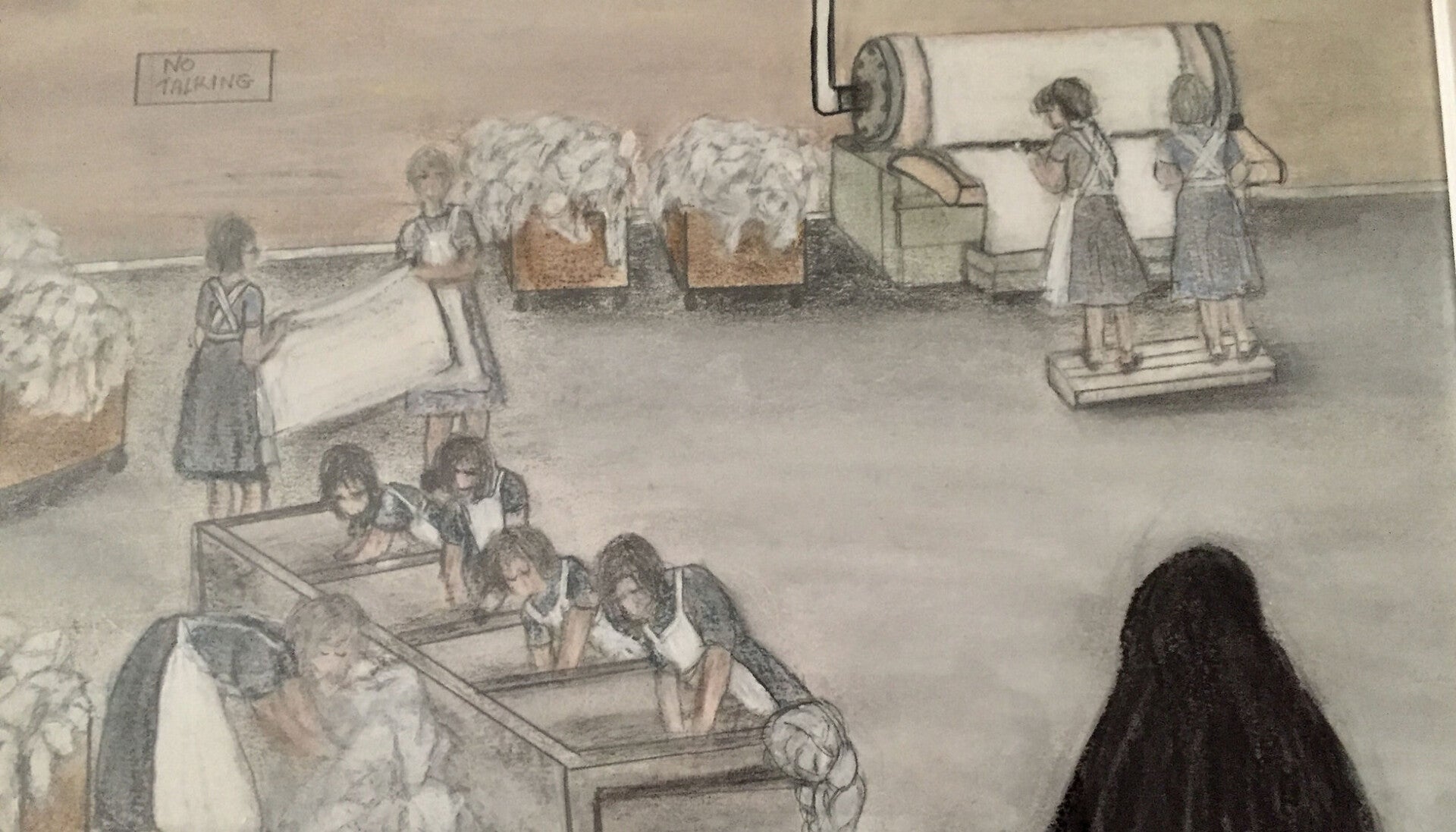
Immediately after breakfast, we were marched single file to the laundry and waited outside until ‘Sister’ came to unlock the door. Once again, all this was done in silence.
I was angry, scared, confused and overwhelmed, with many questions without being permitted to ask them. I was pushed toward a concrete tub and shown what my role was to be in this inhumane situation.


‘Sister’ gave me a washboard and soap. I was shown how to scrub Auckland’s dirty laundry, one article at a time.
This tedious, repetitive labour went on moment by moment, hour after hour, for nine hours a day, with a timed, thirty minute lunch break in the middle of the day. All done in complete silence.
The only thing that kept me from going insane were my thoughts. In fact, most of my thoughts were concentrated on how to escape this nightmare; and indeed, I would meticulously look for and plan my escape.
My Mum and sister were permitted to visit me only three times during my incarceration. These visits were monitored and controlled. The furniture was arranged in such a way, that there was no opportunity to whisper, or pass notes and conversation was only possible when voices were raised.
Should mistakes, or complaints be made, I was severely dealt with later.


In total, I made thirty four attempts to escape and succeeded a majority of the time but because State and Church worked together, my escape attempts only lasted 24hrs of freedom, at a maximum. It goes without saying, that when I was returned, I was subjected to harsh discipline
Eventually, I realised that whilst I had the ability to run away, it was impossible to sustain my freedom because the community, law and church worked together to keep the ‘bad girls’ on the inside of the fence.
Instead, I wrote letters to my Mum, my Social Worker and Mrs Coursey (Birthright Social Worker). However, they never received them because the letters were monitored and interfered with, by the nuns.
One of my letters, eventually got to my Social Worker, a month after I wrote it. I begged her to come and see me. Instead, she wrote me a response, apologising for the delay and dismissed it by saying, “I hope this has sorted itself out.” There was no follow-up.


When I received the letter back from the Social Worker, I realised I would never get rescued, or heard, and I started passing notes to the other girls. We arranged a sit down strike because we knew the nuns were bullies and they attacked us individually but they would not do it if we all stood together. Someone would have to take notice. On our way to our bedrooms, after dinner, we sat on the stairs and refused to move.
Sister Carmel, stared me out, knowing I was behind this.
After a few hours, we needed to go to the bathroom, so we negotiated with the nuns and the they allowed to go to the bathroom one at a time.
That was, until it was my turn, they locked me in the bathroom, grabbed me and marched me to the office. I was disciplined (strapped) and sent to bed.
The next morning, after breakfast, I was summoned to the office, again.
I was given my old clothes and told to get changed.
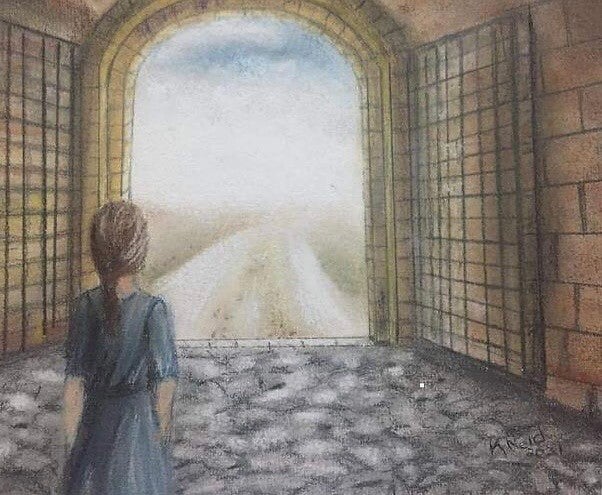
Sister Carmel told me I was “a bad apple” and that a bad apple destroys the whole bunch. She put coins in my hand and sent me out the front door saying, “You will never be any good, no one will ever love you and you are not worth redemption.”
I was free! I was afraid! I didn’t know how to live outside because the world had moved on and I was institutionalised.
I knew one thing, there was no Good Shepherd in ”The Home of The Good Shepherd.”